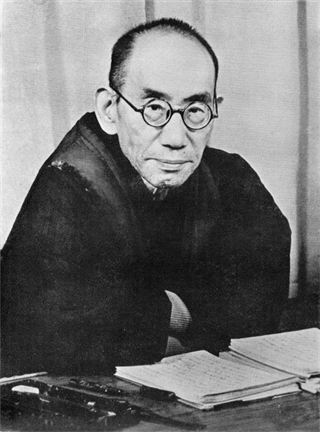
In one sentence
I join Zen Buddhism with Western philosophy around the idea of "absolute nothingness".
How someone from Kyoto School might sum up what they believe. Our summary, not a quotation.
Key thinkers
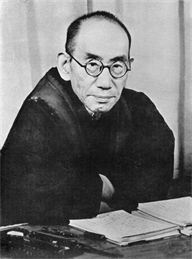 Kitarō Nishida1870–1945 · An Inquiry into the Good
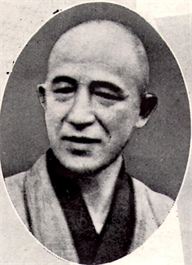 Keiji Nishitani1900–1990 · Religion and Nothingness
Where it leans
A whole worldview, about both. Positions are our estimates; philosophers argue about where many schools belong.
Most unusual position
79%On subjective or objective, it leans further toward subjective than 79% of the 135 schools on the map.
Middle of all schools on the map: 79 · This school: 40 (0 = Subjective, 100 = Objective)
Most typical position
Spirit or matterOn spirit or matter, it is nearest to the other schools on the map, though still not in the middle.
Middle of all schools on the map: 39 · This school: 22 (0 = Spirit, 100 = Matter)
Where it comes from
What came before Kyoto School and led into it, and what grew out of it. Only links that historians agree on.
Came before it
- Zen Buddhism, which Nishida practised for years
- William James, radical empiricism and pure experience (1904)
- G. W. F. Hegel and German idealism (early 19th century)
Grew out of it
- Hajime Tanabe (1930s to 1940s)
- Keiji Nishitani, Religion and Nothingness (1961)
- Masao Abe and Buddhist-Christian dialogue (1960s to 1980s)
One thing to practise
A real practice from Kyoto School, to try this week. Described in our words.
Catch pure experience
When you hear a sound or see a colour, try to stay with the moment before you name it or think of yourself as the one hearing. Nishida held that this moment, before any split between you and what you sense, is pure experience.
From: Kitarō Nishida, An Inquiry into the Good (1911), part 1
Its strongest argument
The best case Kyoto School makes against people who see the world very differently, in two sentences. People whose furthest school this is see it on their result.
In the moment of hearing a sound, before you think that is a bird or I am hearing, there is no self here and world there, only the experience, and Nishida argued this comes first. So if you take your separate self as the obvious starting point, the Kyoto School would say you began from something added later.
The argument in our own words, not a quotation.
Where it sits
On the maps
Each map puts two scales side by side. Each small square is a school, at its exact spot; its name shows where there is room. For the others, point at the square, or tap it once on a phone. The first, Reality & truth, puts spirit or matter across and subjective or objective up and down. Click a school, or tap it again, to open it.
Swipe sideways to see the whole chart.
Thinkers in this school
Pictured thinkers nearest this spot on the map
Neighbours on the map
The six schools closest to this one.
- InstrumentalismScientific theories are useful tools for predicting, not literal descriptions of hidden reality.
- AnimismAnimals, plants, places and objects have spirits or souls of their own.
- RomanticismFeeling, imagination and nature reveal truths that cold reason misses.
- Philosophy of DialogueJewish-German thinkers, above all Buber and Rosenzweig, who hold that a person becomes a self only by truly meeting another, the 'I and Thou', and through that meeting, God.
- Christian ExistentialismKierkegaard's line: each person must face God alone, and faith is a passionate leap rather than a proof.
- HermeneuticsUnderstanding is always interpretation, shaped by the history and point of view the interpreter brings.
And you, where do you stand?
Take the quiz and see your match with Kyoto School and the other 134 schools.
Take the quiz