In one sentence
I sing my love for God in my own language, and I believe that love can save anyone, whatever their birth.
How someone from Bhakti might sum up what they believe. Our summary, not a quotation.
Key thinkers
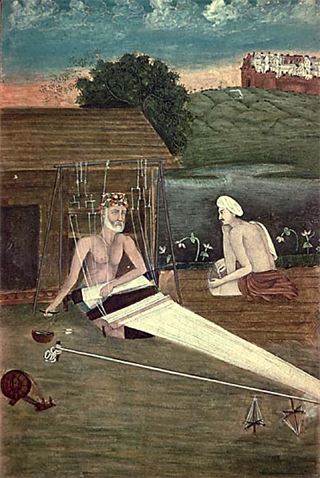
 Kabir15th century · Bijak (attributed)
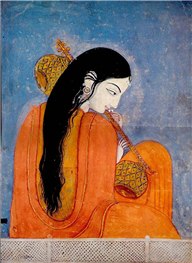 Mirabaic. 1498–1547 · Padavali
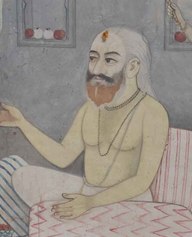 Tulsidas1532–1623 · Ramcharitmanas
Where it leans
A whole worldview, about both. Positions are our estimates; philosophers argue about where many schools belong.
Most unusual position
84%On spirit or matter, it leans further toward spirit than 84% of the 135 schools on the map.
Middle of all schools on the map: 39 · This school: 10 (0 = Spirit, 100 = Matter)
Most typical position
Subjective or objectiveOn subjective or objective, it is nearest to the other schools on the map, though still not in the middle.
Middle of all schools on the map: 79 · This school: 53 (0 = Subjective, 100 = Objective)
Where it comes from
What came before Bhakti and led into it, and what grew out of it. Only links that historians agree on.
Came before it
- Upanishads and the Bhagavad Gita mention bhakti (1st millennium BC)
- The Tamil Alvars and Nayanars (5th to 9th century)
- The Vedanta schools of Ramanuja and Madhva (11th and 12th century)
- The Bhakti Sutras of Shandilya and Narada (12th century)
Grew out of it
- The Kabir Panth (after Kabir's death)
- Sikhism (Guru Nanak, 1469–1539)
- Chaitanya's Gaudiya Vaishnavism (1486–1534)
- The Radha Soami movement (19th century)
One thing to practise
A real practice from Bhakti, to try this week. Described in our words.
Kirtan and bhajan (singing God's names and devotional songs)
Sing songs of love for God, or chant his names, in your own language, alone or with others. In kirtan a group chants together, sometimes in the street with dancing. The songs of the poet-saints, such as Mirabai's, are still sung this way.
From: The poet-saints of the movement; Chaitanya led street kirtan in Bengal in the early 16th century
Its strongest argument
The best case Bhakti makes against people who see the world very differently, in two sentences. People whose furthest school this is see it on their result.
If God is reached by love, then no Sanskrit, no priest, no costly ritual and no high birth is needed, because anyone can love. That is why the poet-saints sang in local languages and opened salvation to women and low castes. To someone who thinks religion is about rules and rank, it says: what God asks of you is a loving heart, and that is something nobody can be born without.
The argument in our own words, not a quotation.
Where it sits
On the maps
Each map puts two scales side by side. Each small square is a school, at its exact spot; its name shows where there is room. For the others, point at the square, or tap it once on a phone. The first, Reality & truth, puts spirit or matter across and subjective or objective up and down. Click a school, or tap it again, to open it.
Swipe sideways to see the whole chart.
Thinkers in this school
Pictured thinkers nearest this spot on the map
Neighbours on the map
The six schools closest to this one.
- JainismAn Indian tradition of non-violence towards all living beings, and the idea that every view holds only part of the truth.
- Kyoto SchoolJapanese philosophers who joined Zen Buddhism with Western philosophy around the idea of "absolute nothingness".
- Christian ExistentialismKierkegaard's line: each person must face God alone, and faith is a passionate leap rather than a proof.
- Analytical PsychologyBeneath the personal mind lies a collective unconscious of shared images, and a good life means growing into your whole self by meeting them.
- HermeticismAncient mystical teachings said to come from Hermes Trismegistus: "as above, so below", and hidden knowledge can unite you with the divine.
- African CommunitarianismAfrican ethics of community, called ubuntu in the south: a person becomes fully a person through other people, so character, sharing and the common good come first.
And you, where do you stand?
Take the quiz and see your match with Bhakti and the other 134 schools.
Take the quiz