In one sentence
I suspend judgement on every question, and peace of mind follows.
How someone from Pyrrhonism might sum up what they believe. Our summary, not a quotation.
Key thinkers
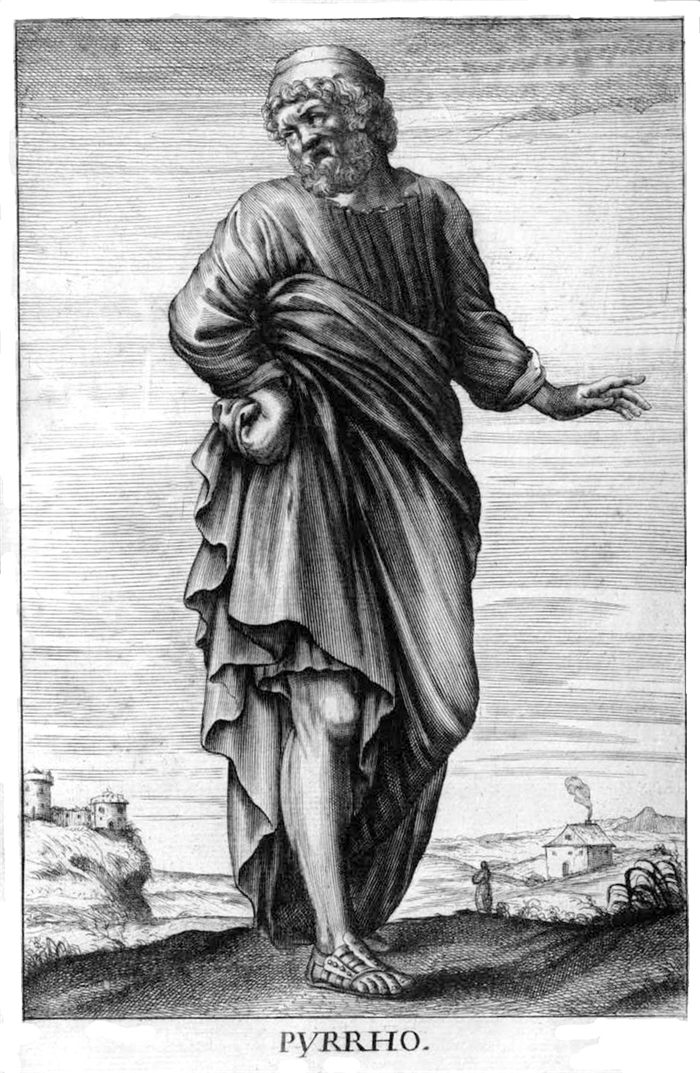
 Pyrrhoc. 360–270 BC · Outlines of Pyrrhonism (by Sextus Empiricus)
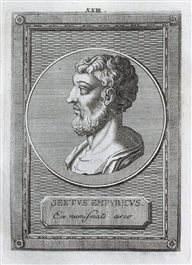 Sextus Empiricusfl. 2nd century AD · Outlines of Pyrrhonism
Where it leans
About what is real and how we know. Positions are our estimates; philosophers argue about where many schools belong.
Most unusual position
99%On facts (subjective or objective), it leans further toward subjective than 99% of the 135 schools on the map.
Middle of all schools on the map: 79 · This school: 5 (0 = subjective, 100 = objective)
Most typical position
Spirit or matterOn spirit or matter, it is nearest to the other schools on the map, though still not in the middle.
Middle of all schools on the map: 39 · This school: 50 (0 = Spirit, 100 = Matter)
Where it comes from
What came before Pyrrhonism and led into it, and what grew out of it. Only links that historians agree on.
Came before it
- Democritus (5th century BC)
- Pyrrho (4th to 3rd century BC)
- Timon of Phlius (3rd century BC)
Grew out of it
- Aenesidemus (1st century BC)
- Sextus Empiricus (2nd to 3rd century)
- Michel de Montaigne (16th century)
- David Hume (18th century)
One thing to practise
A real practice from Pyrrhonism, to try this week. Described in our words.
Set argument against argument
Take a question you feel strongly about. Write the best case for one side, then an equally strong case for the other, until they balance. Then notice whether you can let the question rest without needing to decide it.
From: Sextus Empiricus, Outlines of Pyrrhonism, book 1 (2nd to 3rd century)
Its strongest argument
The best case Pyrrhonism makes against people who see the world very differently, in two sentences. People whose furthest school this is see it on their result.
For any argument you find convincing, someone just as intelligent finds an opposing argument just as convincing, and you have no neutral place to judge between them that is not itself in dispute. So if you hold your views with certainty, the Pyrrhonist asks how you broke that tie, and suggests that letting go of the need to win it brings peace.
The argument in our own words, not a quotation.
Where it sits
On the maps
Each map puts two scales side by side. Each small square is a school, at its exact spot; its name shows where there is room. For the others, point at the square, or tap it once on a phone. The first, Reality & truth, puts spirit or matter across and subjective or objective up and down. Click a school, or tap it again, to open it.
Swipe sideways to see the whole chart.
Thinkers in this school
Pictured thinkers nearest this spot on the map
Neighbours on the map
The six schools closest to this one.
- PostmodernismSuspicion of grand stories and universal truths; knowledge is local, plural and shaped by language and power.
- SkepticismWe cannot know things for certain, so we should doubt claims to knowledge.
- PoststructuralismMeaning is never fixed; language, power and history shape what counts as true or normal.
- TaoismLive in harmony with the Tao, the Way of nature: act without forcing, stay simple, and softness overcomes hardness.
- SophistsAncient Greek teachers who were paid to teach persuasion and how to succeed; the best known, Protagoras, said "man is the measure of all things", making truth depend on the person.
- Social ConstructionismMuch of what we take as natural, like categories and norms, is built by society and could have been different.
And you, where do you stand?
Take the quiz and see your match with Pyrrhonism and the other 134 schools.
Take the quiz