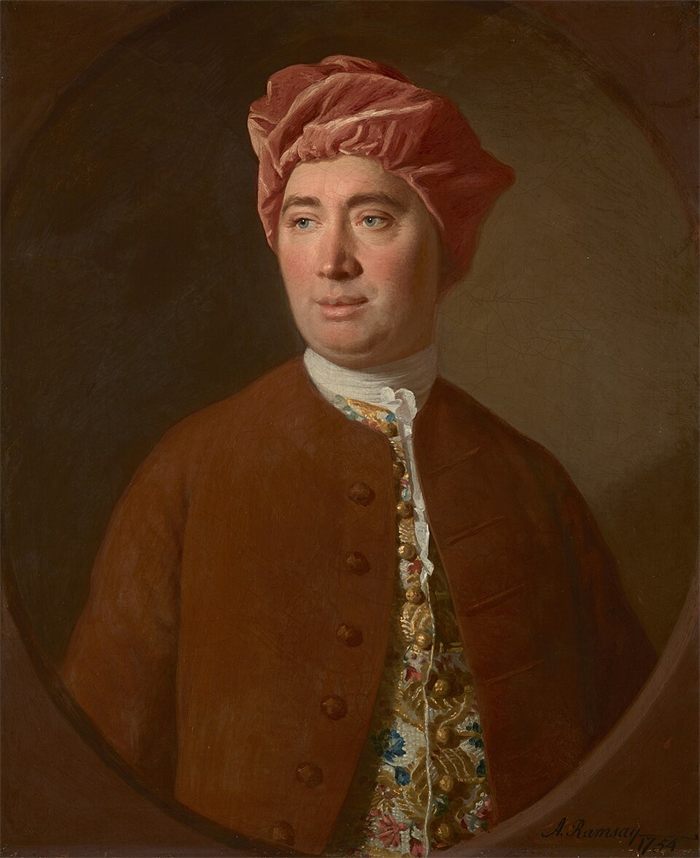

In one sentence
All my knowledge comes from experience, no argument can prove the future will be like the past, and reason serves my feelings and desires.
David Hume's view as we would sum it up in their voice. Our summary, not a quotation.
Key book
A Treatise of Human Nature1739–1740Tries to explain the mind from experience: ideas copy sense impressions, cause and effect is a habit of expectation, and reason serves our feelings.School: Humeanism
Circle: The Scottish Enlightenment · part of it from 1738 · end not recorded
In the rivalry Rationalists against Empiricists: The Empiricists
Where David Hume leans
Positions are our estimates from their main works, not scores they gave themselves.
Most unusual position
70%On universals are real or only particular things, David Hume leans further toward only particular things existing than 70% of the 61 thinkers on this site.
Middle of all thinkers on this site: 25 · David Hume: 90 (0 = Universals are real, 100 = Only particular things)
Most typical position
Individual or collectiveOn individual or collective, David Hume is nearest to the other thinkers on this site, though still not in the middle.
Middle of all thinkers on this site: 65 · David Hume: 55 (0 = Individual, 100 = Collective)
Side by side with you
Black dot: this thinker. Red ring: you.
On the maps
Each map puts two scales side by side. Each small square is a school, at its exact spot; its name shows where there is room. For the others, point at the square, or tap it once on a phone. The first, Reality & truth, puts spirit or matter across and subjective or objective up and down. Click a school, or tap it again, to open it.
Swipe sideways to see the whole chart.
Thinkers like this one
Pictured thinkers closest to this one
And you, where do you stand?
Take the quiz and see your match with David Hume and the other 743 thinkers.
Take the quiz