In one sentence
I see reality as spirit coming to know itself through history, as each idea meets its opposite and both rise into something higher.
How someone from Hegelianism might sum up what they believe. Our summary, not a quotation.
Key thinkers
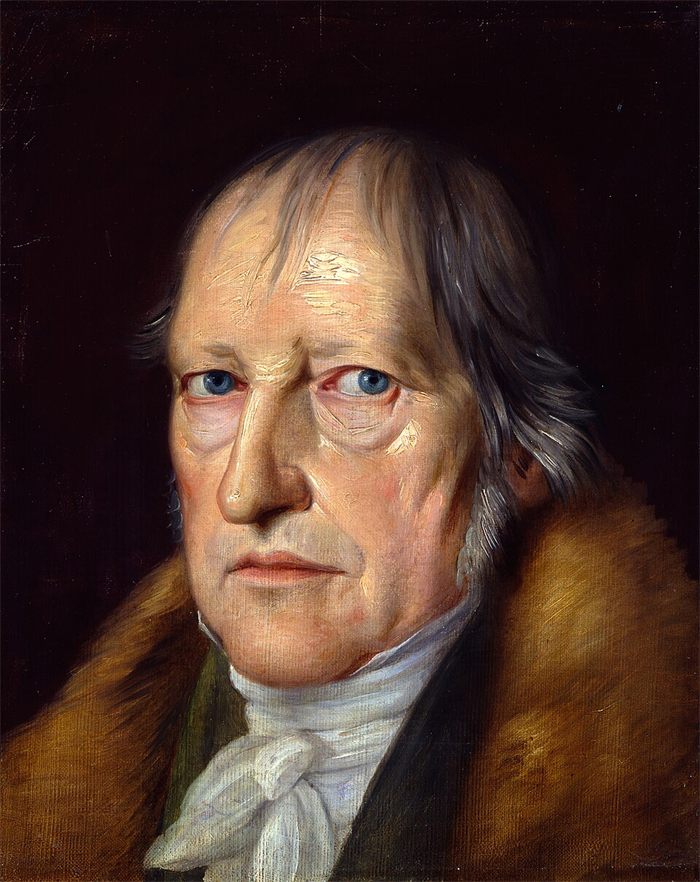
 G. W. F. Hegel1770–1831 · Phenomenology of Spirit
 Alexandre Kojève1902–1968 · Introduction to the Reading of Hegel
 Robert Pippinborn 1948 · Hegel's Idealism: The Satisfactions of Self-Consciousness
 Ivan Ilyin1883–1954 · O soprotivlenii zlu siloyu (On Resistance to Evil by Force)
Where it leans
A whole worldview, about both. Positions are our estimates; philosophers argue about where many schools belong.
Most unusual position
74%On spirit or matter, it leans further toward spirit than 74% of the 135 schools on the map.
Middle of all schools on the map: 39 · This school: 15 (0 = Spirit, 100 = Matter)
Most typical position
Subjective or objectiveOn subjective or objective, it is nearest to the other schools on the map, though still not in the middle.
Middle of all schools on the map: 79 · This school: 95 (0 = Subjective, 100 = Objective)
Where it comes from
What came before Hegelianism and led into it, and what grew out of it. Only links that historians agree on.
Came before it
- Heraclitus (around 500 BC)
- Immanuel Kant (18th century)
- Johann Gottlieb Fichte (1790s)
- Friedrich Wilhelm Joseph Schelling (around 1800)
Grew out of it
- Ludwig Feuerbach and the Young Hegelians (1830s to 1840s)
- Karl Marx (19th century)
- F. H. Bradley and Josiah Royce (late 19th century)
One thing to practise
A real practice from Hegelianism, to try this week. Described in our words.
The realist's morning prayer
Read the day's news as Hegel did, not for gossip but to see where your own age stands. For each big story, ask what conflict is being fought and what each side gets right.
From: G. W. F. Hegel, aphorisms in his Jena notebook, the Wastebook (around 1803 to 1806)
Its strongest argument
The best case Hegelianism makes against people who see the world very differently, in two sentences. People whose furthest school this is see it on their result.
Hegel's case is that history shows freedom growing step by step, from one ruler being free, to some citizens being free, to the idea that all people are free, and each step came from a clash the older view could not settle on its own terms. So if you treat your views as fixed truths outside history, ask what clash produced them.
The argument in our own words, not a quotation.
Where it sits
On the maps
Each map puts two scales side by side. Each small square is a school, at its exact spot; its name shows where there is room. For the others, point at the square, or tap it once on a phone. The first, Reality & truth, puts spirit or matter across and subjective or objective up and down. Click a school, or tap it again, to open it.
Swipe sideways to see the whole chart.
Thinkers in this school
Pictured thinkers nearest this spot on the map
Neighbours on the map
The six schools closest to this one.
- PythagoreanismPythagoras' community: the soul is immortal and reborn, the world is ordered by number, and a disciplined shared life of silence and purity frees the soul.
- Transcendent PhilosophyMulla Sadra's school: existence itself is the one reality, in degrees; all things keep moving toward God, and philosophy joins reasoning, mystical insight and scripture.
- Mu'tazilaEarly Islamic rationalist theology: God is one and perfectly just, so humans freely create their own acts, and reason can tell good from evil.
- Reformed EpistemologyChristian philosophers' view that belief in God can be rational, even knowledge, without arguments or evidence, just like belief in other minds or in the past.
- PlatonismBehind the changing world are perfect, unchanging Forms like Justice and Beauty, and reason, not the senses, can know them.
- Dvaita VedantaA Hindu school holding that God, souls and matter are forever different and real, and souls are freed only by God's grace through devotion.
And you, where do you stand?
Take the quiz and see your match with Hegelianism and the other 134 schools.
Take the quiz