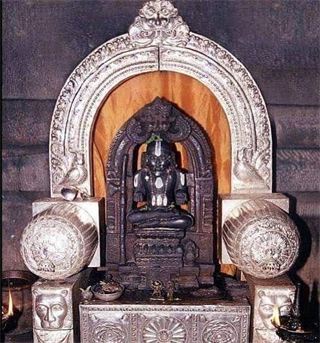
In one sentence
I hold that God, my soul and the world are forever distinct and real, and that only God's grace can set me free.
How someone from Dvaita Vedanta might sum up what they believe. Our summary, not a quotation.
Key thinkers
 Madhvacharyac. 1238–1317 · Anuvyakhyana
 Jayatirtha1356–1388 · Nyaya Sudha (Nectar of Logic)
Where it leans
A whole worldview, about both. Positions are our estimates; philosophers argue about where many schools belong.
Most unusual position
84%On spirit or matter, it leans further toward spirit than 84% of the 135 schools on the map.
Middle of all schools on the map: 39 · This school: 10 (0 = Spirit, 100 = Matter)
Most typical position
Subjective or objectiveOn subjective or objective, it is nearest to the other schools on the map, though still not in the middle.
Middle of all schools on the map: 79 · This school: 95 (0 = Subjective, 100 = Objective)
Where it comes from
What came before Dvaita Vedanta and led into it, and what grew out of it. Only links that historians agree on.
Came before it
- Shankara's Advaita, the school Madhva attacked (9th century)
- Ramanuja's Vishishtadvaita (12th century)
Grew out of it
- Jayatirtha (pontiff 1365 to 1388)
- Vyasatirtha (1478–1589 per the IEP)
- The Haridasa movement of devotional songs in Kannada
- Influence on Chaitanya's Bengal Vaishnavism (Chaitanya 1486–1534)
One thing to practise
A real practice from Dvaita Vedanta, to try this week. Described in our words.
Hearing, reflecting, meditating (sravana, manana, nididhyasana)
Study the scriptures with a teacher, then think them through until the doubts are gone, then meditate on God's endless good qualities. Do this together with honest living and loving devotion. The aim is a direct vision of God, which the school says comes through God's grace.
From: Madhvacharya (13th century, Udupi), who stressed the guru's guidance
Its strongest argument
The best case Dvaita Vedanta makes against people who see the world very differently, in two sentences. People whose furthest school this is see it on their result.
Every day we experience that we are different from each other and from God. If that experience were an illusion, we could not trust anything we perceive, not even our reading of scripture, which also reaches us through perception and inference. So scripture must be read in line with experience, and it teaches real and lasting differences. To someone who trusts the senses but doubts religion, it says: the same trust in what you see is what makes the difference between you and God real.
The argument in our own words, not a quotation.
Where it sits
On the maps
Each map puts two scales side by side. Each small square is a school, at its exact spot; its name shows where there is room. For the others, point at the square, or tap it once on a phone. The first, Reality & truth, puts spirit or matter across and subjective or objective up and down. Click a school, or tap it again, to open it.
Swipe sideways to see the whole chart.
Thinkers in this school
Pictured thinkers nearest this spot on the map
Neighbours on the map
The six schools closest to this one.
- PlatonismBehind the changing world are perfect, unchanging Forms like Justice and Beauty, and reason, not the senses, can know them.
- AugustinianismAugustine's view that people are fallen and need God's grace, and that true happiness is found only in God.
- Ash'arismThe main Sunni theology: God directly creates every event and act, good is what God commands, and reason defends the faith but cannot set right and wrong alone.
- VishishtadvaitaA Hindu school holding that God is one, yet souls and the world are truly real as his body, and loving surrender to God brings freedom.
- HegelianismReality is spirit coming to know itself through history, as each idea meets its opposite and both are lifted into something higher.
- PerennialismAll the great religions point to one shared, timeless truth beneath their different surfaces.
And you, where do you stand?
Take the quiz and see your match with Dvaita Vedanta and the other 134 schools.
Take the quiz