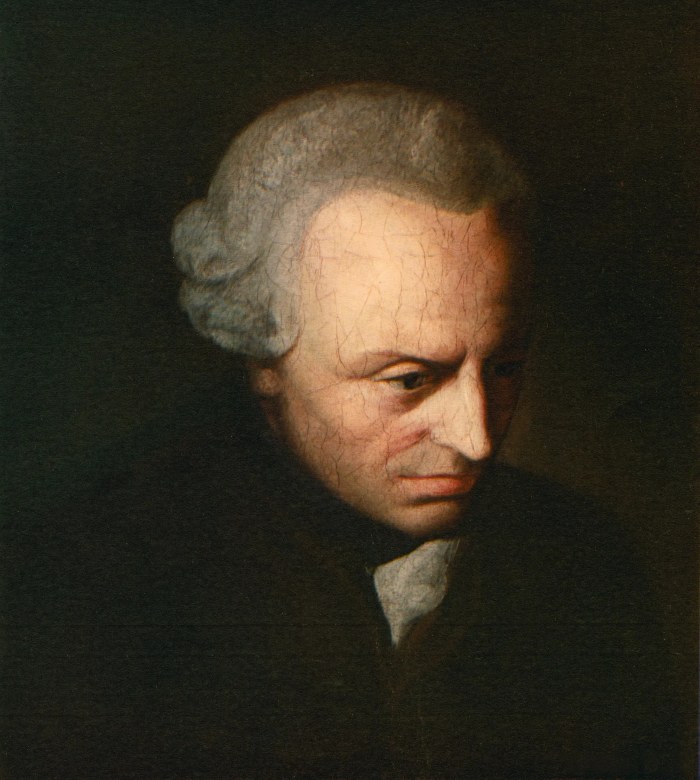
In one sentence
My mind shapes how I experience the world, and acting morally means acting only on rules everyone could follow.
How someone from Kantianism might sum up what they believe. Our summary, not a quotation.
Key thinkers
 Immanuel Kant1724–1804 · Critique of Pure Reason
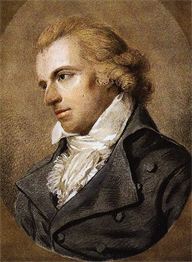 Friedrich Schiller1759–1805 · On the Aesthetic Education of Man
Where it leans
A whole worldview, about both. Positions are our estimates; philosophers argue about where many schools belong.
Most unusual position
56%On subjective or objective, it leans further toward subjective than 56% of the 135 schools on the map.
Middle of all schools on the map: 79 · This school: 75 (0 = Subjective, 100 = Objective)
Most typical position
Spirit or matterOn spirit or matter, it sits close to the middle of the schools on the map.
Middle of all schools on the map: 39 · This school: 35 (0 = Spirit, 100 = Matter)
Where it comes from
What came before Kantianism and led into it, and what grew out of it. Only links that historians agree on.
Came before it
- Gottfried Wilhelm Leibniz (17th century)
- David Hume (18th century)
- Jean-Jacques Rousseau (18th century)
Grew out of it
- Johann Gottlieb Fichte (1790s)
- G. W. F. Hegel (19th century)
- Neo-Kantianism (late 19th century)
- John Rawls (20th century)
One thing to practise
A real practice from Kantianism, to try this week. Described in our words.
The universal law test
Before a choice you are unsure about, write down the rule you would be acting on, for example: I may break a promise when it suits me. Ask whether you could want everyone to act on that rule. If it would collapse, or you could not want it, do not act on it.
From: Immanuel Kant, Groundwork of the Metaphysics of Morals (1785), section 2
Its strongest argument
The best case Kantianism makes against people who see the world very differently, in two sentences. People whose furthest school this is see it on their result.
A lying promise works only because most promises are kept; if everyone lied whenever it suited them, promising would collapse, so the liar makes an exception for himself that reason cannot defend. So if you think right and wrong are only feelings or results, ask why you resent being the one used as a mere tool.
The argument in our own words, not a quotation.
Where it sits
On the maps
Each map puts two scales side by side. Each small square is a school, at its exact spot; its name shows where there is room. For the others, point at the square, or tap it once on a phone. The first, Reality & truth, puts spirit or matter across and subjective or objective up and down. Click a school, or tap it again, to open it.
Swipe sideways to see the whole chart.
Thinkers in this school
Pictured thinkers nearest this spot on the map
Neighbours on the map
The six schools closest to this one.
- ConfucianismA good life and a good society come from virtue, respect, ritual and duty within the family and the state.
- MohismMozi's ancient Chinese school: care for everyone equally, judge actions by how much they benefit people, and take Heaven's will as the standard.
- PantheismGod and the universe are the same thing; the divine is everywhere in nature.
- LongtermismPeople who will live in the future count as much as people alive today, and there may be vastly more of them, so protecting the long-term future comes first.
- CypherpunkPrivacy and freedom will not be granted by governments or companies, so people must protect them themselves by building and using strong cryptography.
- PessimismLife holds more suffering than happiness; Schopenhauer, its best-known voice, traced this to a blind, restless will that drives everything, and saw compassion as what eases it.
And you, where do you stand?
Take the quiz and see your match with Kantianism and the other 134 schools.
Take the quiz