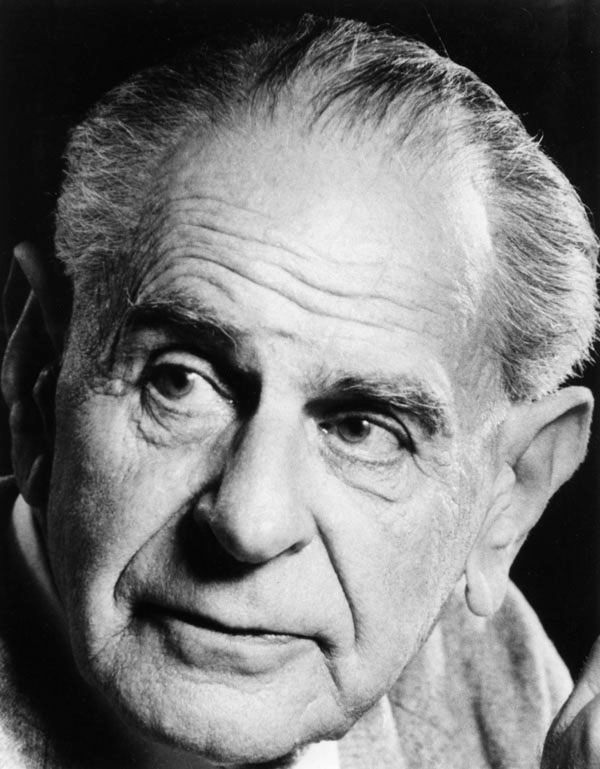
In one sentence
With Popper, I say knowledge grows by bold guesses and attempts to prove them wrong, never by proof.
How someone from Critical Rationalism might sum up what they believe. Our summary, not a quotation.
Key thinkers
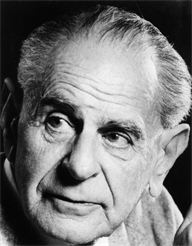 Karl Popper1902–1994 · The Logic of Scientific Discovery
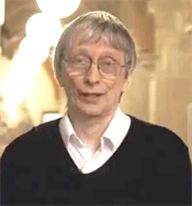 David Deutschborn 1953 · The Beginning of Infinity: Explanations that Transform the World
Where it leans
About what is real and how we know. Positions are our estimates; philosophers argue about where many schools belong.
Most unusual position
81%On spirit or matter, it leans further toward matter than 81% of the 135 schools on the map.
Middle of all schools on the map: 39 · This school: 80 (0 = Spirit, 100 = Matter)
Most typical position
FactsOn facts (subjective or objective), it is nearest to the other schools on the map, though still not in the middle.
Middle of all schools on the map: 79 · This school: 90 (0 = subjective, 100 = objective)
Where it comes from
What came before Critical Rationalism and led into it, and what grew out of it. Only links that historians agree on.
Came before it
- David Hume, the problem of induction (18th century)
- Albert Einstein, the risky eclipse prediction tested in 1919
- Logical Positivism (which Popper argued against, 1920s to 1930s)
Grew out of it
- Imre Lakatos, research programmes (1970)
- Paul Feyerabend, Against Method (1975), a former follower turned critic
- David Deutsch, The Beginning of Infinity (2011)
One thing to practise
A real practice from Critical Rationalism, to try this week. Described in our words.
Name what would refute you
Pick a belief you hold firmly and write down, in advance, what observation would make you give it up. If you cannot name one, Popper would say the belief is not being tested at all.
From: Karl Popper, Conjectures and Refutations (1963), chapter 1
Its strongest argument
The best case Critical Rationalism makes against people who see the world very differently, in two sentences. People whose furthest school this is see it on their result.
No number of white swans can prove that all swans are white, yet one black swan proves it false, so the honest way to test a belief is to look hard for what would refute it. So if you mostly collect evidence that agrees with you, Popper would say you have not tested your view, only decorated it.
The argument in our own words, not a quotation.
Where it sits
On the maps
Each map puts two scales side by side. Each small square is a school, at its exact spot; its name shows where there is room. For the others, point at the square, or tap it once on a phone. The first, Reality & truth, puts spirit or matter across and subjective or objective up and down. Click a school, or tap it again, to open it.
Swipe sideways to see the whole chart.
Thinkers in this school
Pictured thinkers nearest this spot on the map
Neighbours on the map
The six schools closest to this one.
- Scientific RealismOur best scientific theories are roughly true, and the unseen things they describe, like electrons, really exist.
- Evolutionary EthicsOur moral feelings were shaped by evolution because they helped our ancestors survive together.
- ObjectivismAyn Rand's view: reality is objective, reason is our only guide, and each person should live by rational self-interest, with their own happiness as life's moral purpose.
- Milesian schoolThe first Greek philosophers, in Miletus: explain nature by one basic stuff and natural causes instead of gods, and test each other's theories in open debate.
- Rationalist CommunityTrain yourself to think clearly with evidence and probability, catch your own biases, change your mind, and take big risks like dangerous AI seriously.
- Hard DeterminismEvery event, including every choice, is fixed by earlier causes, so free will is an illusion.
And you, where do you stand?
Take the quiz and see your match with Critical Rationalism and the other 134 schools.
Take the quiz