The two camps
Medieval philosophers agreed that people can think and talk about universals, but disagreed on whether universals exist in reality. Aquinas and Duns Scotus became realism’s biggest proponents; Ockham, the most influential and thorough nominalist, argued that universals are a product of abstract human thought. Abelard’s view is sometimes called conceptualism, a middle way between nominalism and realism.
In our words.
A. The Realists
Placed at the average of these 3 people.
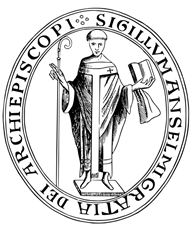 Anselm of Canterbury1033–1109
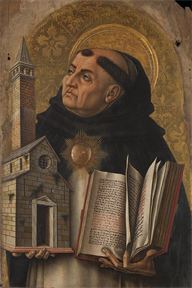 Thomas Aquinas1225–1274
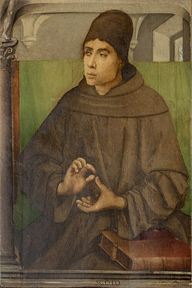 Duns Scotusc. 1266–1308
B. The Nominalists
Placed at the average of these 2 people.
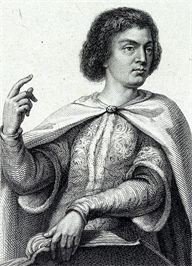 Peter Abelard1079–1142
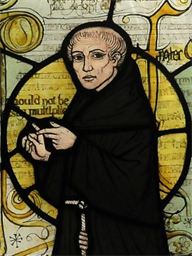 William of Ockhamc. 1287–1347
Where they part ways
Each scale both camps have a position on, the biggest gap first.
The RealistsThe Nominalists
The big letters are each camp's average; the small dots are its members (filled: The Realists, open: The Nominalists). A camp whose members are far apart on a scale is marked split.
Your side
Take the quiz to see which camp you would have joined.
Sources
Where each camp comes from: the exact words on each page.
Philosophers agree that human beings can talk and think about universals, but disagree on whether universals exist in reality beyond mere thought and speech
wikipedia.orgWhen the nominalist Roscelin attempted to appeal to the authority of Lanfranc and Anselm at his trial for the heresy of tritheism at Soissons in 1092
wikipedia.orgAnselm composed the first draft of De Fide Trinitatis as a rebuttal and as a defence of Trinitarianism and universals
wikipedia.orgRealism’s biggest proponents in the Middle Ages, however, came to be Thomas Aquinas and Duns Scotus
wikipedia.orgScotus believed that such properties as ‘redness’ and ‘roundness’ exist in reality and are mind-independent entities
wikipedia.orgarguing instead for Scotist realism, a medieval response to the conceptualism of Abelard
wikipedia.orgNominalist ideas can be found in the work of Peter Abelard and reached their flowering in William of Ockham, who was the most influential and thorough nominalist
wikipedia.orgAbelard’s and Ockham’s version of nominalism is sometimes called conceptualism, which presents itself as a middle way between nominalism and realism
wikipedia.orgWilliam of Ockham (1285-1347) wrote extensively on this topic. He argued strongly that universals are a product of abstract human thought
wikipedia.orgthe edict issued by Louis XI in 1474 commanding that realism alone (as contained in scholars such as Averroes, Albert the Great, Aquinas, Duns Scotus and Bonaventure ) be taught at the University of Paris
wikipedia.org
And you, where do you stand?
Take the quiz and see which side of Realists or Nominalists you are on.
Take the quiz