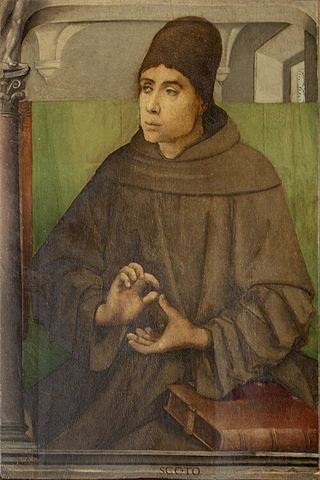
The author in one sentence
I hold that the will is free in the full sense, able to choose otherwise, and that each thing is this very thing and no other.
Duns Scotus's view as we would sum it up in their voice. Our summary, not a quotation.
Where Duns Scotus leans
Spirit or matterVery strong · Spirit
Spirit 90%Matter 10%
Facts: subjective or objectiveVery strong · Objective
Subjective 5%Objective 95%
Values: subjective or objectiveVery strong · Objective
Subjective 15%Objective 85%
Free will or determinismVery strong · Free will
Free will 90%Determinism 10%
Reason or experienceStrong · Reason
Reason 70%Experience 30%
Separate from the highest, or one with itVery strong · Separate
Separate 90%All is one 10%
Inner life: real, or explained away by the brainVery strong · Mind is real
Mind is real 90%Mind explained away 10%
Life: meaning, or none at allVery strong · Life has meaning
Life has meaning 95%No meaning at all 5%
The way to the highest: own effort, or graceLeaning · By grace
By my own effort 35%By grace 65%
What makes an act right: principles, or consequencesVery strong · Principles
Principles 95%Consequences 5%
God: exists, or notVery strong · God exists
God exists 100%No God 0%
Universals: real, or only particular thingsStrong · Universals are real
Universals are real 75%Only particular things 25%
Knowledge: we can know, or suspend judgmentVery strong · We can know
We can know 95%Suspend judgment 5%

And you, where do you stand?
Take the quiz and see how close you are to Duns Scotus.
Take the quiz